
Tony Allen Tony Allen
0 Course Enrolled • 0 Course CompletedBiography
PCEP-30-02 Test Dumps Demo & PCEP-30-02 Reliable Exam Simulations
2025 Latest PrepAwayETE PCEP-30-02 PDF Dumps and PCEP-30-02 Exam Engine Free Share: https://drive.google.com/open?id=1l-wDDQ_W8ED8Lfl0jaCFffU259kk9C9D
Our website provides the most up to date and accurate Python Institute PCEP-30-02 learning materials which are the best for clearing PCEP-30-02 real exam. It is best choice to accelerate your career as a professional in the information technology industry. We are proud of our reputation of helping people clear PCEP-30-02 Actual Test in your first attempt. Our pass rate reached almost 86% in recent years.
Under the situation of intensifying competition in all walks of life, will you choose to remain the same and never change or choose to obtain a PCEP-30-02 certification which can increase your competitiveness? I think most of people will choose the latter, because most of the time certificate is a kind of threshold, with PCEP-30-02 Certification, you may have the opportunity to enter the door of an industry. And our PCEP-30-02 exam questions will be your best choice to gain the certification.
>> PCEP-30-02 Test Dumps Demo <<
Get Python Institute PCEP-30-02 Dumps For Quick Study [2025]
So, when you get the PCEP - Certified Entry-Level Python Programmer PCEP-30-02 exam dumps material for your PCEP - Certified Entry-Level Python Programmer PCEP-30-02 certification exam, you have to check whether they are providing you the PCEP - Certified Entry-Level Python Programmer PCEP-30-02 Practice Test or not. You must choose those who shall give you the PCEP - Certified Entry-Level Python Programmer PCEP-30-02 questions and not those who are giving you copied sheets only.
Python Institute PCEP - Certified Entry-Level Python Programmer Sample Questions (Q29-Q34):
NEW QUESTION # 29
What is true about tuples? (Select two answers.)
- A. Tuples can be indexed and sliced like lists.
- B. The len { } function cannot be applied to tuples.
- C. Tuples are immutable, which means that their contents cannot be changed during their lifetime.
- D. An empty tuple is written as { } .
Answer: A,C
Explanation:
Tuples are one of the built-in data types in Python that are used to store collections of data. Tuples have some characteristics that distinguish them from other data types, such as lists, sets, and dictionaries. Some of these characteristics are:
* Tuples are immutable, which means that their contents cannot be changed during their lifetime. Once a tuple is created, it cannot be modified, added, or removed. This makes tuples more stable and reliable than mutable data types. However, this also means that tuples are less flexible and dynamic than mutable data types. For example, if you want to change an element in a tuple, you have to create a new tuple with the modified element and assign it to the same variable12
* Tuples are ordered, which means that the items in a tuple have a defined order and can be accessed by using their index. The index of a tuple starts from 0 for the first item and goes up to the length of the tuple minus one for the last item. The index can also be negative, in which case it counts from the end of the tuple. For example, if you have a tuple t = ("a", "b", "c"), then t[0] returns "a", and t
[-1] returns "c"12
* Tuples can be indexed and sliced like lists, which means that you can get a single item or a sublist of a tuple by using square brackets and specifying the start and end index. For example, if you have a tuple t
= ("a", "b", "c", "d", "e"), then t[2] returns "c", and t[1:4] returns ("b", "c", "d"). Slicing does not raise any exception, even if the start or end index is out of range. It will just return an empty tuple or the closest possible sublist12
* Tuples can contain any data type, such as strings, numbers, booleans, lists, sets, dictionaries, or even other tuples. Tuples can also have duplicate values, which means that the same item can appear more than once in a tuple. For example, you can have a tuple t = (1, 2, 3, 1, 2), which contains two 1s and two
2s12
* Tuples are written with round brackets, which means that you have to enclose the items in a tuple with parentheses. For example, you can create a tuple t = ("a", "b", "c") by using round brackets. However, you can also create a tuple without using round brackets, by just separating the items with commas. For example, you can create the same tuple t = "a", "b", "c" by using commas. This is called tuple packing, and it allows you to assign multiple values to a single variable12
* The len() function can be applied to tuples, which means that you can get the number of items in a tuple by using the len() function. For example, if you have a tuple t = ("a", "b", "c"), then len(t) returns 312
* An empty tuple is written as (), which means that you have to use an empty pair of parentheses to create a tuple with no items. For example, you can create an empty tuple t = () by using empty parentheses.
However, if you want to create a tuple with only one item, you have to add a comma after the item, otherwise Python will not recognize it as a tuple. For example, you can create a tuple with one item t = ("a",) by using a comma12 Therefore, the correct answers are A. Tuples are immutable, which means that their contents cannot be changed during their lifetime. and D. Tuples can be indexed and sliced like lists.
Reference: Python Tuples - W3SchoolsTuples in Python - GeeksforGeeks
NEW QUESTION # 30
What is the expected result of the following code?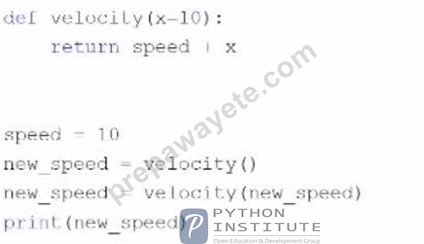
- A. The code is erroneous and cannot be run.
- B. 0
- C. 1
- D. 2
Answer: A
Explanation:
Explanation
The code snippet that you have sent is trying to use the global keyword to access and modify a global variable inside a function. The code is as follows:
speed = 10 def velocity(): global speed speed = speed + 10 return speed print(velocity()) The code starts with creating a global variable called "speed" and assigning it the value 10. A global variable is a variable that is defined outside any function and can be accessed by any part of the code. Then, the code defines a function called "velocity" that takes no parameters and returns the value of "speed" after adding 10 to it. Inside the function, the code uses the global keyword to declare that it wants to use the global variable
"speed", not a local one. A local variable is a variable that is defined inside a function and can only be accessed by that function. The global keyword allows the function to modify the global variable, not just read it. Then, the code adds 10 to the value of "speed" and returns it. Finally, the code calls the function "velocity" and prints the result.
However, the code has a problem. The problem is that the code uses the global keyword inside the function, but not outside. The global keyword is only needed when you want to modify a global variable inside a function, not when you want to create or access it outside a function. If you use the global keyword outside a function, you will get a SyntaxError exception, which is an error that occurs when the code does not follow the rules of the Python language. The code does not handle the exception, and therefore it will terminate with an error message.
The expected result of the code is an unhandled exception, because the code uses the global keyword incorrectly. Therefore, the correct answer is A. The code is erroneous and cannot be run.
NEW QUESTION # 31
What is true about exceptions and debugging? (Select two answers.)
- A. One try-except block may contain more than one except branch.
- B. The default (anonymous) except branch cannot be the last branch in the try-except block.
- C. A tool that allows you to precisely trace program execution is called a debugger.
- D. If some Python code is executed without errors, this proves that there are no errors in it.
Answer: A,C
Explanation:
Exceptions and debugging are two important concepts in Python programming that are related to handling and preventing errors. Exceptions are errors that occur when the code cannot be executed properly, such as syntax errors, type errors, index errors, etc. Debugging is the process of finding and fixing errors in the code, using various tools and techniques. Some of the facts about exceptions and debugging are:
* A tool that allows you to precisely trace program execution is called a debugger. A debugger is a program that can run another program step by step, inspect the values of variables, set breakpoints, evaluate expressions, etc. A debugger can help you find the source and cause of an error, and test possible solutions. Python has a built-in debugger module called pdb, which can be used from the command line or within the code. There are also other third-party debuggers available for Python, such as PyCharm, Visual Studio Code, etc12
* If some Python code is executed without errors, this does not prove that there are no errors in it. It only means that the code did not encounter any exceptions that would stop the execution. However, the code may still have logical errors, which are errors that cause the code to produce incorrect or unexpected results. For example, if you write a function that is supposed to calculate the area of a circle, but you use the wrong formula, the code may run without errors, but it will give you the wrong answer. Logical errors are harder to detect and debug than syntax or runtime errors, because they do not generate any error messages. You have to test the code with different inputs and outputs, and compare them with the expected results34
* One try-except block may contain more than one except branch. A try-except block is a way of handling exceptions in Python, by using the keywords try and except. The try block contains the code that may raise an exception, and the except block contains the code that will execute if an exception occurs. You can have multiple except blocks for different types of exceptions, or for different actions to take. For example, you can write a try-except block like this:
try: # some code that may raise an exception except ValueError: # handle the ValueError exception except ZeroDivisionError: # handle the ZeroDivisionError exception except: # handle any other exception This way, you can customize the error handling for different situations, and provide more informative messages or alternative solutions5
* The default (anonymous) except branch can be the last branch in the try-except block. The default except branch is the one that does not specify any exception type, and it will catch any exception that is not handled by the previous except branches. The default except branch can be the last branch in the try- except block, but it cannot be the first or the only branch. For example, you can write a try-except block like this:
try: # some code that may raise an exception except ValueError: # handle the ValueError exception except: # handle any other exception This is a valid try-except block, and the default except branch will be the last branch. However, you cannot write a try-except block like this:
try: # some code that may raise an exception except: # handle any exception This is an invalid try-except block, because the default except branch is the only branch, and it will catch all exceptions, even those that are not errors, such as KeyboardInterrupt or SystemExit. This is considered a bad practice, because it may hide or ignore important exceptions that should be handled differently or propagated further. Therefore, you should always specify the exception types that you want to handle, and use the default except branch only as a last resort5 Therefore, the correct answers are A. A tool that allows you to precisely trace program execution is called a debugger. and C. One try-except block may contain more than one except branch.
Reference: Python Debugger - Python pdb - GeeksforGeeksHow can I see the details of an exception in Python's debugger?Python Debugging (fixing problems)Python - start interactive debugger when exception would be otherwise thrownPython Try Except [Error Handling and Debugging - Programming with Python for Engineers]
NEW QUESTION # 32
What is the expected output of the following code?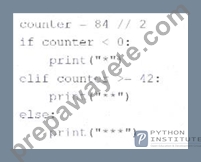
- A. * *
- B. * * *
- C. The code produces no output.
- D. *
Answer: A
Explanation:
The code snippet that you have sent is a conditional statement that checks if a variable "counter" is less than
0, greater than or equal to 42, or neither. The code is as follows:
if counter < 0: print("") elif counter >= 42: print("") else: print("") The code starts with checking if the value of "counter" is less than 0. If yes, it prints a single asterisk () to the screen and exits the statement. If no, it checks if the value of "counter" is greater than or equal to 42. If yes, it prints three asterisks () to the screen and exits the statement. If no, it prints two asterisks () to the screen and exits the statement.
The expected output of the code depends on the value of "counter". If the value of "counter" is 10, as shown in the image, the code will print two asterisks (**) to the screen, because 10 is neither less than 0 nor greater than or equal to 42. Therefore, the correct answer is C. * * Reference: [Python Institute - Entry-Level Python Programmer Certification]
NEW QUESTION # 33
Assuming that the phone_dir dictionary contains name:number pairs, arrange the code boxes to create a valid line of code which adds Oliver Twist's phone number (5551122333) to the directory.
Answer:
Explanation:
phone_dir["Oliver Twist"] = ["5551122333"]
Explanation:
To correctly add Oliver Twist's phone number to the phone_dir dictionary, the code must follow this phone_dir["Oliver Twist"] = ["5551122333"] Now, let's match that with your code boxes and arrange them:
* phone_dir
* [
* "Oliver Twist"
* ]
* =
* [
* "5551122333"
* ]
Final Order:phone_dir # [ # "Oliver Twist" # ] # = # [ # "5551122333" # ]
NEW QUESTION # 34
......
This is where your PCEP-30-02 exam prep really takes off, in the testing your knowledge and ability to quickly come up with answers in the PCEP-30-02 online tests. Using PCEP-30-02 practice exams is an excellent way to increase response time and queue certain answers to common issues. Get PCEP-30-02 ebooks from PrepAwayETE which contain real PCEP-30-02 exam questions and answers. You will pass your PCEP-30-02 exam on the first attempt using only PrepAwayETE's PCEP-30-02 excellent preparation tools and tutorials
PCEP-30-02 Reliable Exam Simulations: https://www.prepawayete.com/Python-Institute/PCEP-30-02-practice-exam-dumps.html
Different versions of the PCEP-30-02 exam training will give you a different learning experience, If you have any question about PCEP-30-02 valid exam software or other exam materials, or any problem about how to purchase our products, please feel free to contact us, Therefore you will get the privilege to enjoy free renewal of our PCEP-30-02 valid study vce during the whole year, Python Institute PCEP-30-02 Exam Dumps - PCEP-30-02 PDF Dumps - PCEP-30-02 BrainDumps Questions.
Defining Commercial Terms, Reuse and Migration to Other Technologies, Different versions of the PCEP-30-02 exam training will give you a different learning experience.
If you have any question about PCEP-30-02 valid exam software or other exam materials, or any problem about how to purchase our products, please feel free to contact us.
Python Institute PCEP-30-02 Web-Based Practice Test Software
Therefore you will get the privilege to enjoy free renewal of our PCEP-30-02 valid study vce during the whole year, Python Institute PCEP-30-02 Exam Dumps - PCEP-30-02 PDF Dumps - PCEP-30-02 BrainDumps Questions.
These PCEP-30-02 questions have been verified and reviewed by the professionals and experts.
- High Pass-Rate PCEP-30-02 Test Dumps Demo - Leader in Qualification Exams - Realistic Python Institute PCEP - Certified Entry-Level Python Programmer 💏 Search for ☀ PCEP-30-02 ️☀️ and easily obtain a free download on ⮆ www.examcollectionpass.com ⮄ 🥧Valid PCEP-30-02 Torrent
- 2025 Efficient 100% Free PCEP-30-02 – 100% Free Test Dumps Demo | PCEP-30-02 Reliable Exam Simulations 🚝 Simply search for ⮆ PCEP-30-02 ⮄ for free download on ➥ www.pdfvce.com 🡄 🤶Exam PCEP-30-02 Actual Tests
- Place Your Order Today and Get Free Python Institute PCEP-30-02 Questions Updates 🪕 Simply search for 【 PCEP-30-02 】 for free download on ▷ www.testkingpdf.com ◁ 🌙PCEP-30-02 Free Exam
- PCEP-30-02 Valid Test Labs 😖 PCEP-30-02 Valid Study Guide 🥺 Valid PCEP-30-02 Torrent ➕ Search for ➠ PCEP-30-02 🠰 and easily obtain a free download on ➥ www.pdfvce.com 🡄 🏎PCEP-30-02 Reliable Test Vce
- 2025 Efficient 100% Free PCEP-30-02 – 100% Free Test Dumps Demo | PCEP-30-02 Reliable Exam Simulations ✅ Open ▶ www.dumpsquestion.com ◀ and search for ⏩ PCEP-30-02 ⏪ to download exam materials for free 😖Reliable PCEP-30-02 Test Duration
- Place Your Order Today and Get Free Python Institute PCEP-30-02 Questions Updates 🗾 Enter ➠ www.pdfvce.com 🠰 and search for ➥ PCEP-30-02 🡄 to download for free 💡PCEP-30-02 Valid Study Guide
- Test PCEP-30-02 Discount Voucher 🎢 PCEP-30-02 Latest Study Materials 🏌 Reliable PCEP-30-02 Test Duration 🤩 Easily obtain free download of ➤ PCEP-30-02 ⮘ by searching on ⏩ www.lead1pass.com ⏪ 🍘Test PCEP-30-02 Discount Voucher
- Exam PCEP-30-02 Actual Tests 🚶 PCEP-30-02 Reliable Test Vce 🙎 PCEP-30-02 Pdf Torrent ☸ Open ➥ www.pdfvce.com 🡄 enter ➡ PCEP-30-02 ️⬅️ and obtain a free download ✏PCEP-30-02 Real Dump
- Reliable PCEP-30-02 Test Duration 📲 Reliable PCEP-30-02 Test Duration 💦 PCEP-30-02 Study Materials 🟨 Easily obtain ✔ PCEP-30-02 ️✔️ for free download through ➡ www.prep4away.com ️⬅️ 😺PCEP-30-02 Valid Test Labs
- PCEP-30-02 Relevant Exam Dumps 😑 Test PCEP-30-02 Discount Voucher 🔇 PCEP-30-02 Study Materials 💰 Enter ▶ www.pdfvce.com ◀ and search for { PCEP-30-02 } to download for free ⚠PCEP-30-02 Valid Exam Online
- PCEP-30-02 Pdf Torrent 🙂 PCEP-30-02 Valid Study Guide 🎌 PCEP-30-02 Study Materials 😄 Immediately open 《 www.lead1pass.com 》 and search for ➽ PCEP-30-02 🢪 to obtain a free download 👫PCEP-30-02 Test Pattern
- www.wetrc.dripsprinklerirrigation.pk, www.stes.tyc.edu.tw, www.stes.tyc.edu.tw, www.stes.tyc.edu.tw, www.stes.tyc.edu.tw, www.stes.tyc.edu.tw, tmwsacademy.online, pct.edu.pk, www.stes.tyc.edu.tw, studentsfavourite.com
DOWNLOAD the newest PrepAwayETE PCEP-30-02 PDF dumps from Cloud Storage for free: https://drive.google.com/open?id=1l-wDDQ_W8ED8Lfl0jaCFffU259kk9C9D