
Sid Tate Sid Tate
0 Course Enrolled • 0 Course CompletedBiography
確保通過的CNSP證照資訊|第一次嘗試輕鬆學習並通過考試和完美的CNSP:Certified Network Security Practitioner
從Google Drive中免費下載最新的PDFExamDumps CNSP PDF版考試題庫:https://drive.google.com/open?id=1mvgneg0h2oLQSQOj83Ovs4K7fEQ_tVBF
我們PDFExamDumps網站是個歷史悠久的The SecOps Group的CNSP考試認證培訓資料網站。在認證IT行業已經有很久了,所以才有今天赫赫有名的地位及知名度,這都是幫助那些考生而得到的結果。我們的The SecOps Group的CNSP考試認證培訓資料包含試題及答案,這些資料是由我們資深的IT專家團隊通過自己的知識及不斷摸索的經驗而研究出來的,它的內容有包含真實的考試題,如果你要參加The SecOps Group的CNSP考試認證,選擇PDFExamDumps是無庸置疑的選擇。
The SecOps Group CNSP 考試大綱:
| 主題 | 簡介 |
|---|---|
| 主題 1 |
|
| 主題 2 |
|
| 主題 3 |
|
| 主題 4 |
|
| 主題 5 |
|
| 主題 6 |
|
| 主題 7 |
|
| 主題 8 |
|
| 主題 9 |
|
| 主題 10 |
|
| 主題 11 |
|
| 主題 12 |
|
| 主題 13 |
|
| 主題 14 |
|
| 主題 15 |
|
| 主題 16 |
|
| 主題 17 |
|
| 主題 18 |
|
CNSP考古题推薦,CNSP熱門考古題
誰想要獲得The SecOps Group CNSP認證?我們所知道的該考試是非常具有挑戰性的,隨著最新的CNSP考古題上線,您將更方便快捷的獲得認證。如果您不相信我們,可以先下載我們的免費PDF試用版的CNSP問題和答案,我們將保證您100%成功。對于擁有高品質的The SecOps Group CNSP題庫是絕對值得信賴的,為了配合當真正的考試,我們的專家在不斷的更新我們的問題和答案。如果使用我們的CNSP考古題沒有通過考試,我們將無條件的退款。
最新的 Security Practitioner CNSP 免費考試真題 (Q53-Q58):
問題 #53
According to the screenshot below, which of the following statements are correct?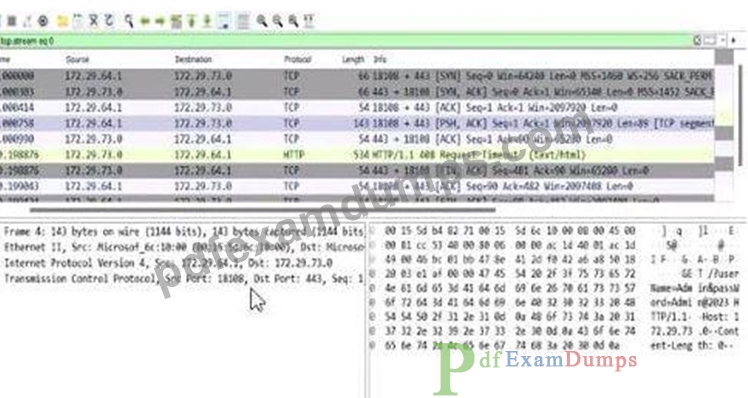
- A. The credentials have been submitted over the HTTPS protocol.
- B. The application is running on port 443 and the HTTPS protocol.
- C. The credentials have been submitted over the HTTP protocol.
- D. The application is running on port 80 and the HTTP protocol.
答案:B
解題說明:
The screenshot is from Wireshark, a network protocol analyzer, displaying captured network traffic. The relevant columns include the source and destination IP addresses, ports, protocol, and additional information about the packets. Let's break down the details:
Destination Port Analysis: The screenshot shows multiple packets with a destination port of 443 (e.g., in the "Destination" column, entries like "172.72.61.9:443"). Port 443 is the default port for HTTPS (HTTP Secure), which is HTTP traffic encrypted using SSL/TLS. This indicates that the application is communicating over HTTPS.
Protocol Analysis: The "Protocol" column lists "TLSv1.2" for most packets (e.g., frame numbers 2000084, 2000086). TLS (Transport Layer Security) is the cryptographic protocol used by HTTPS to secure HTTP communications. This confirms that the traffic is HTTPS, not plain HTTP.
Packet Details: The "Info" column provides additional context, such as "Application Data" for TLS packets, indicating encrypted application-layer data (typical of HTTPS). There are also HTTP packets (e.g., frame 2000088), but these are likely part of the HTTPS session (e.g., HTTP/2 over TLS, as noted by "HTTP2").
Now, let's evaluate the options:
Option A: "The application is running on port 443 and the HTTPS protocol." This is correct. The destination port 443 and the use of TLSv1.2 confirm that the application is using HTTPS. HTTPS is the standard protocol for secure web communication, and port 443 is its designated port. CNSP documentation emphasizes that HTTPS traffic on port 443 indicates a secure application-layer protocol, often used for web applications handling sensitive data.
Option B: "The credentials have been submitted over the HTTP protocol." This is incorrect. HTTP typically uses port 80, but the screenshot shows traffic on port 443 with TLS, indicating HTTPS. Credentials submitted over this connection would be encrypted via HTTPS, not sent in plaintext over HTTP. CNSP highlights the security risks of HTTP for credential submission due to lack of encryption, which isn't the case here.
Option C: "The credentials have been submitted over the HTTPS protocol." While this statement could be true (since HTTPS is in use, any credentials would likely be submitted securely), the question asks for the "correct" statement based on the screenshot. The screenshot doesn't explicitly show credential submission (e.g., a POST request with form data); it only shows the protocol and port. Option A is more directly supported by the screenshot as it focuses on the application's protocol and port, not the specific action of credential submission. CNSP notes that HTTPS ensures confidentiality, but this option requires more specific evidence of credentials.
Option D: "The application is running on port 80 and the HTTP protocol." This is incorrect. Port 80 is the default for HTTP, but the screenshot clearly shows port 443 and TLS, indicating HTTPS. CNSP documentation contrasts HTTP (port 80, unencrypted) with HTTPS (port 443, encrypted), making this option invalid.
Conclusion: Option A is the most accurate and comprehensive statement directly supported by the screenshot, confirming the application's use of port 443 and HTTPS. While Option C might be true in a broader context, it's less definitive without explicit evidence of credential submission in the captured packets.
問題 #54
Which one of the following services is not a UDP-based protocol?
- A. SSH
- B. IKE
- C. NTP
- D. SNMP
答案:A
解題說明:
Protocols are defined by their transport layer usage (TCP or UDP), impacting their security and performance characteristics.
Why D is correct: SSH (Secure Shell) uses TCP (port 22) for reliable, connection-oriented communication, unlike the UDP-based options. CNSP contrasts TCP and UDP protocol security.
Why other options are incorrect:
A: SNMP uses UDP (ports 161, 162) for lightweight network management.
B: NTP uses UDP (port 123) for time synchronization.
C: IKE (IPsec key exchange) uses UDP (ports 500, 4500).
問題 #55
Which command will perform a DNS zone transfer of the domain "victim.com" from the nameserver at 10.0.0.1?
- A. dig @10.0.0.1 victim.com axfr
- B. dig @10.0.0.1 victim.com axrfr
- C. dig @10.0.0.1 victim.com arfxr
- D. dig @10.0.0.1 victim.com afxr
答案:A
解題說明:
A DNS zone transfer replicates an entire DNS zone (a collection of DNS records for a domain) from a primary nameserver to a secondary one, typically for redundancy or load balancing. The AXFR (Authoritative Full Zone Transfer) query type, defined in RFC 1035, facilitates this process. The dig (Domain Information Groper) tool, a staple in Linux/Unix environments, is used to query DNS servers. The correct syntax is:
dig @<nameserver> <domain> axfr
Here, dig @10.0.0.1 victim.com axfr instructs dig to request a zone transfer for "victim.com" from the nameserver at 10.0.0.1. The @ symbol specifies the target server, overriding the system's default resolver.
Technical Details:
The AXFR query is sent over TCP (port 53), not UDP, due to the potentially large size of zone data, which exceeds UDP's typical 512-byte limit (pre-EDNS0).
Successful execution requires the nameserver to permit zone transfers from the querying IP, often restricted to trusted secondaries via Access Control Lists (ACLs) for security. If restricted, the server responds with a "REFUSED" error.
Security Implications: Zone transfers expose all DNS records (e.g., A, MX, NS), making them a reconnaissance goldmine for attackers if misconfigured. CNSP likely emphasizes securing DNS servers against unauthorized AXFR requests, using tools like dig to test vulnerabilities.
Why other options are incorrect:
A . dig @10.0.0.1 victim.com axrfr: "axrfr" is a typographical error. The correct query type is "axfr." Executing this would result in a syntax error or an unrecognized query type response from dig.
B . dig @10.0.0.1 victim.com afxr: "afxr" is another typo, not a valid DNS query type per RFC 1035. dig would fail to interpret this, likely outputting an error like "unknown query type." C . dig @10.0.0.1 victim.com arfxr: "arfxr" is also invalid, a jumbled version of "axfr." It holds no meaning in DNS protocol standards and would fail similarly.
Real-World Context: Penetration testers use dig ... axfr to identify misconfigured DNS servers. For example, dig @ns1.example.com example.com axfr might reveal subdomains or internal IPs if not locked down.
問題 #56
What RID is given to an Administrator account on a Microsoft Windows machine?
- A. 0
- B. 1
- C. 2
- D. 3
答案:A
解題說明:
In Windows, security principals (users, groups) are identified by a Security Identifier (SID), formatted as S-1-<authority>-<domain>-<RID>. The RID (Relative Identifier) is the final component, unique within a domain or machine. For local accounts:
RID 500: Assigned to the built-in Administrator account on every Windows machine (e.g., S-1-5-21-<machine>-500).
Created during OS install, with full system privileges.
Disabled by default in newer Windows versions (e.g., 10/11) unless explicitly enabled.
RID 501: Guest account (e.g., S-1-5-21-<machine>-501), limited access.
Technical Details:
Stored in SAM (C:WindowsSystem32configSAM).
Enumeration: Tools like wmic useraccount or net user reveal RIDs.
Domain Context: Domain Admins use RID 512, but the question specifies a local machine.
Security Implications: RID 500 is a prime target for brute-forcing or pass-the-hash attacks (e.g., Mimikatz). CNSP likely advises renaming/disabling it (e.g., via GPO).
Why other options are incorrect:
A . 0: Reserved (e.g., Null SID, S-1-0-0), not a user RID.
C . 501: Guest, not Administrator.
D . 100: Invalid; local user RIDs start at 1000 (e.g., custom accounts).
Real-World Context: Post-compromise, attackers query RID 500 (e.g., net user Administrator) for privilege escalation.
問題 #57
Which of the following statements regarding Authorization and Authentication is true?
- A. Authorization is the process where requests to access a particular resource are granted or denied. Authentication is providing and validating the identity.
- B. Authentication is the process where requests to access a particular resource are granted or denied. Authorization is providing and validating identity.
- C. Authentication includes the execution rules that determine what functionality and data the user can access. Authentication and Authorization are both the same thing.
- D. Authentication controls which processes a person can use and which files they can access, read, or modify. Authentication and authorization typically do not operate together, thus making it impossible to determine who is accessing the information.
答案:A
解題說明:
Authentication and Authorization (often abbreviated as AuthN and AuthZ) are foundational pillars of access control in network security:
Authentication (AuthN): Verifies "who you are" by validating credentials against a trusted source. Examples include passwords, MFA (multi-factor authentication), certificates, or biometrics. It ensures the entity (user, device) is legitimate, typically via protocols like Kerberos or LDAP.
Authorization (AuthZ): Determines "what you can do" after authentication, enforcing policies on resource access (e.g., read/write permissions, API calls). It relies on mechanisms like Access Control Lists (ACLs), Role-Based Access Control (RBAC), or Attribute-Based Access Control (ABAC).
Option A correctly separates these roles:
Authorization governs access decisions (e.g., "Can user X read file Y?").
Authentication establishes identity (e.g., "Is this user X?").
In practice, these processes are sequential: AuthN precedes AuthZ. For example, logging into a VPN authenticates your identity (e.g., via username/password), then authorizes your access to specific subnets based on your role. CNSP likely stresses this distinction for designing secure systems, as conflating them risks privilege escalation or identity spoofing vulnerabilities.
Why other options are incorrect:
B: Reverses the definitions-Authentication doesn't grant/deny access (that's AuthZ), and Authorization doesn't validate identity (that's AuthN). This mix-up could lead to flawed security models.
C: Falsely equates AuthN and AuthZ and attributes access rules to AuthN. They're distinct processes; treating them as identical undermines granular control (e.g., NIST SP 800-53 separates IA-2 for AuthN and AC-3 for AuthZ).
D: Misassigns access control to AuthN and claims they don't interoperate, which is false-they work together in every modern system (e.g., SSO with RBAC). This would render auditing impossible, contradicting security best practices.
Real-World Context: A web server (e.g., Apache) authenticates via HTTP Basic Auth, then authorizes via .htaccess rules-two separate steps.
問題 #58
......
PDFExamDumps的專家團隊利用他們的經驗和知識終於研究出了關於The SecOps Group CNSP 認證考試的培訓資料。我們的The SecOps Group CNSP 認證考試培訓資料很受客戶歡迎,這是PDFExamDumps的專家團隊勤勞勞動的結果。他們研究出來的模擬測試題及答案有很高的品質,和真實的考試題目有95%的相似性,是很值得你依賴的。如果你使用了PDFExamDumps的培訓工具,你可以100%通過你的第一次參加的The SecOps Group CNSP認證考試。
CNSP考古题推薦: https://www.pdfexamdumps.com/CNSP_valid-braindumps.html
- 100%有保障的CNSP證照資訊,最好的學習資料幫助妳快速通過CNSP考試 🐫 在《 tw.fast2test.com 》網站上免費搜索➥ CNSP 🡄題庫CNSP證照信息
- 高水平的CNSP證照資訊,最新的考試指南幫助妳輕松通過CNSP考試 🏃 立即到▶ www.newdumpspdf.com ◀上搜索⇛ CNSP ⇚以獲取免費下載CNSP認證考試
- CNSP考試心得 🥅 CNSP題庫 🍵 CNSP證照信息 👴 到▷ www.vcesoft.com ◁搜尋( CNSP )以獲取免費下載考試資料CNSP考試心得
- CNSP 免費題庫答案轉儲-通過 CNSP - Certified Network Security Practitioner 認證考試 👍 打開✔ www.newdumpspdf.com ️✔️搜尋➽ CNSP 🢪以免費下載考試資料CNSP考題寶典
- 可靠的CNSP證照資訊和資格考試中的領先提供者和快速下載CNSP:Certified Network Security Practitioner 🚔 透過⏩ tw.fast2test.com ⏪搜索➽ CNSP 🢪免費下載考試資料CNSP認證考試
- CNSP題庫 💾 CNSP考題寶典 🎃 CNSP考古題分享 🙆 立即在➡ www.newdumpspdf.com ️⬅️上搜尋▷ CNSP ◁並免費下載CNSP考試
- 最有效的CNSP證照資訊,免費下載CNSP考試資料幫助妳通過CNSP考試 😸 立即在➽ tw.fast2test.com 🢪上搜尋( CNSP )並免費下載CNSP證照信息
- 頂尖的CNSP證照資訊 |高通過率的考試材料|免費下載CNSP考古题推薦 🤣 在[ www.newdumpspdf.com ]網站下載免費✔ CNSP ️✔️題庫收集CNSP認證考試
- CNSP考古題介紹 🥐 CNSP最新考證 🖕 CNSP考證 🤸 開啟▶ www.vcesoft.com ◀輸入“ CNSP ”並獲取免費下載CNSP在線考題
- 利用CNSP證照資訊 - 不用擔心Certified Network Security Practitioner ⭕ 到{ www.newdumpspdf.com }搜尋( CNSP )以獲取免費下載考試資料CNSP測試題庫
- 最受推薦的的CNSP證照資訊,覆蓋大量的The SecOps Group認證CNSP考試知識點 🕙 免費下載✔ CNSP ️✔️只需進入☀ tw.fast2test.com ️☀️網站CNSP考試備考經驗
- www.stes.tyc.edu.tw, cta.etrendx.com, pct.edu.pk, ycs.instructure.com, kareyed271.idblogmaker.com, lms.ait.edu.za, shortcourses.russellcollege.edu.au, www.stes.tyc.edu.tw, www.stes.tyc.edu.tw, myportal.utt.edu.tt, myportal.utt.edu.tt, myportal.utt.edu.tt, myportal.utt.edu.tt, myportal.utt.edu.tt, myportal.utt.edu.tt, myportal.utt.edu.tt, myportal.utt.edu.tt, myportal.utt.edu.tt, myportal.utt.edu.tt, Disposable vapes
P.S. PDFExamDumps在Google Drive上分享了免費的2025 The SecOps Group CNSP考試題庫:https://drive.google.com/open?id=1mvgneg0h2oLQSQOj83Ovs4K7fEQ_tVBF